Fathers and Families Coalition of America • Experiential Learning
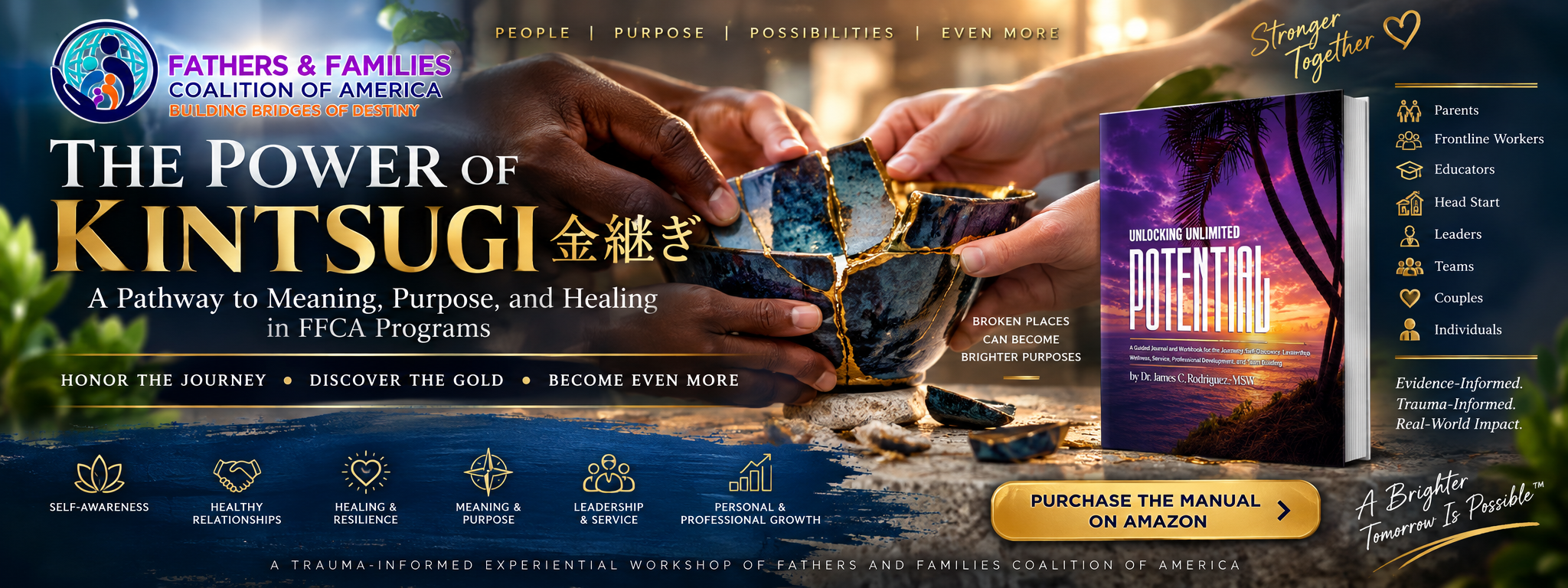
The Power of Kintsugi 金継ぎ
At Fathers and Families Coalition of America, healing-centered practice and effective leadership begin with a purposeful discovery of self. Our work brings theory and application together for transformation—and invites transformation to move toward transcendence.
More Than an Activity
You Are Not the Broken Piece. You Are the Person Holding the Possibility.
Kintsugi is the Japanese art of repairing broken pottery so that the places of repair become visible rather than concealed. Within FFCA learning experiences, that image becomes a powerful metaphor for examining adversity, identity, relationships, resilience, meaning and the possibilities that remain within us.
The purpose is not to romanticize trauma or suggest that people must be broken in order to grow. Instead, participants are invited to acknowledge experiences that have shaped them, recognize strengths they may have developed along the way, and intentionally consider what they want to carry forward.
That is why this experience can speak to a parent sitting beside an educator, a frontline practitioner beside an executive, a couple beside a community leader, or an experienced professional beside someone just beginning the journey.
From Experience to Application
A Journey From the Vessel to Purpose
Kintsugi gives participants something tangible to hold while exploring concepts that can otherwise remain abstract. The experience moves intentionally from awareness toward application.
The Vessel Intact
Recognize existing strengths, experiences, relationships, values and wisdom already being carried.
Embracing the Break
Make room for vulnerability, awareness and insight without reducing a person to what happened to them.
The Golden Repair
Explore meaning, reframing, resilience, relationships, purpose and the strengths that can support restoration.
Purpose in Practice
Carry insight into relationships, parenting, service, teamwork, leadership and meaningful action.
Whole-Person Development
Four Dimensions. One Human Being.
FFCA organizes this work through four interconnected dimensions of development. The goal is not simply knowledge acquisition, but deeper understanding that can be translated into intentional action.
Psychological
Awareness, beliefs, identity, interpretation, meaning-making and the stories through which we understand experience.
Emotional
Recognition, regulation, empathy, compassion, emotional intelligence and healthier ways of relating to self and others.
Behavioral
Moving insight into choices, habits, communication, relationships, leadership practices and sustained action.
Noological
Exploring meaning, values, purpose, contribution and the possibility of transcending self toward something larger.
Integrative Learning
Where Theory Meets Application
The Kintsugi experience does not stand alone. FFCA uses it as an experiential bridge connecting multiple perspectives on self-awareness, relationships, resilience, meaning and growth.
Kintsugi 金継ぎ
The visible repair becomes a metaphor for honoring history without allowing adversity to become the entirety of one's identity.
Ikigai 生き甲斐 & Meaning
Reflection on values, interests, contribution and purpose helps participants ask not simply what happened, but what they want their lives and leadership to move toward.
Logotherapy
Viktor Frankl's meaning-centered perspective contributes questions of purpose, responsibility, love, creativity and how people may orient themselves toward meaning even in difficult circumstances.
Narrative Reflection
Participants examine the stories they tell about themselves and consider whether those stories leave room for agency, growth, possibility and a developing future.
Schema-Informed Reflection
Guided questions help participants notice recurring patterns, assumptions and relational responses that may influence how they understand themselves and interact with others.
Cognitive & Behavioral Tools
Reflection and reframing are connected to practical choices so that insight has an opportunity to become intentional behavior.
Emotional Intelligence
Self-awareness, emotional regulation, empathy and relationship awareness become part of the conversation about how we show up for ourselves and for others.
Mindfulness & Compassion
Present-moment reflection encourages participants to slow the process, observe without immediate judgment and practice compassion toward self and others.
Why Kintsugi?
One Experience. Multiple Pathways for Growth.
Reframing Adversity
Honor the journey. Challenges do not have to be erased or hidden for a person to move forward.
The process creates room to consider resilience and post-traumatic growth without suggesting that suffering itself was necessary or desirable.
Making Healing Tangible
Move beyond lecture. Meaning, forgiveness, resilience and restoration can be difficult to understand only through words.
A hands-on experience provides a visual and sensory anchor for reflection, self-awareness and intentional growth.
Deepening Human Connection
Make room for authenticity. Shared reflection can reduce isolation and challenge the pressure to appear flawless.
In teams, families and learning communities, the metaphor can open conversations about empathy, relationships, psychological safety and continuous growth.
Building a Bridge to Purpose
Move from insight toward service. Understanding our own experiences can deepen the empathy with which we parent, teach, practice, supervise and lead.
Personal development can therefore become relational development, professional growth and meaningful contribution.
Across FFCA Learning Experiences
Not a Stand-Alone Idea—Part of a Larger Developmental Model
Trauma-informed, meaning-centered and resilience-oriented concepts are woven throughout FFCA's professional-development architecture.
Advanced Practitioner Credential™ Course
Kintsugi supports the Trauma-Informed Care Practices component by connecting trauma awareness, reflection, meaning, resilience and practical application.
OAR Leadership Institute™
The philosophy contributes to leadership development through self-awareness, relationships, emotional intelligence, purpose and the movement from personal insight toward responsible leadership.
FFCA DiSC Learning
Trauma-informed reflection complements conversations about behavioral adaptation, masking, self-awareness and how experiences can influence the ways people show up in relationships, teams and leadership.
An Invitation to Experience the Work
It Is Engaging. It Is Hands-On. And It May Challenge You.
FFCA has used this learning experience with parents, practitioners, professionals, organizational leaders and other participants in virtual, in-person and contracted learning environments. We also make complimentary institute opportunities available periodically as part of our commitment to strengthening people and communities.
The reason the activity can reach across titles and professions is simple: before someone is a psychiatrist, CEO, philanthropist, pastor, parent, educator, beginning practitioner or executive, they are a human being.
Kintsugi turns the conversation inward before asking participants to carry it outward. You examine what you have experienced, what you have learned, what you value, what you may still be carrying, and what you want to become.
You are an active participant in your growth. Your experience matters. Your story matters. Your choices matter. And there may still be even more within you.
Continue the Experience
The Learning Does Not Have to End When the Workshop Ends.
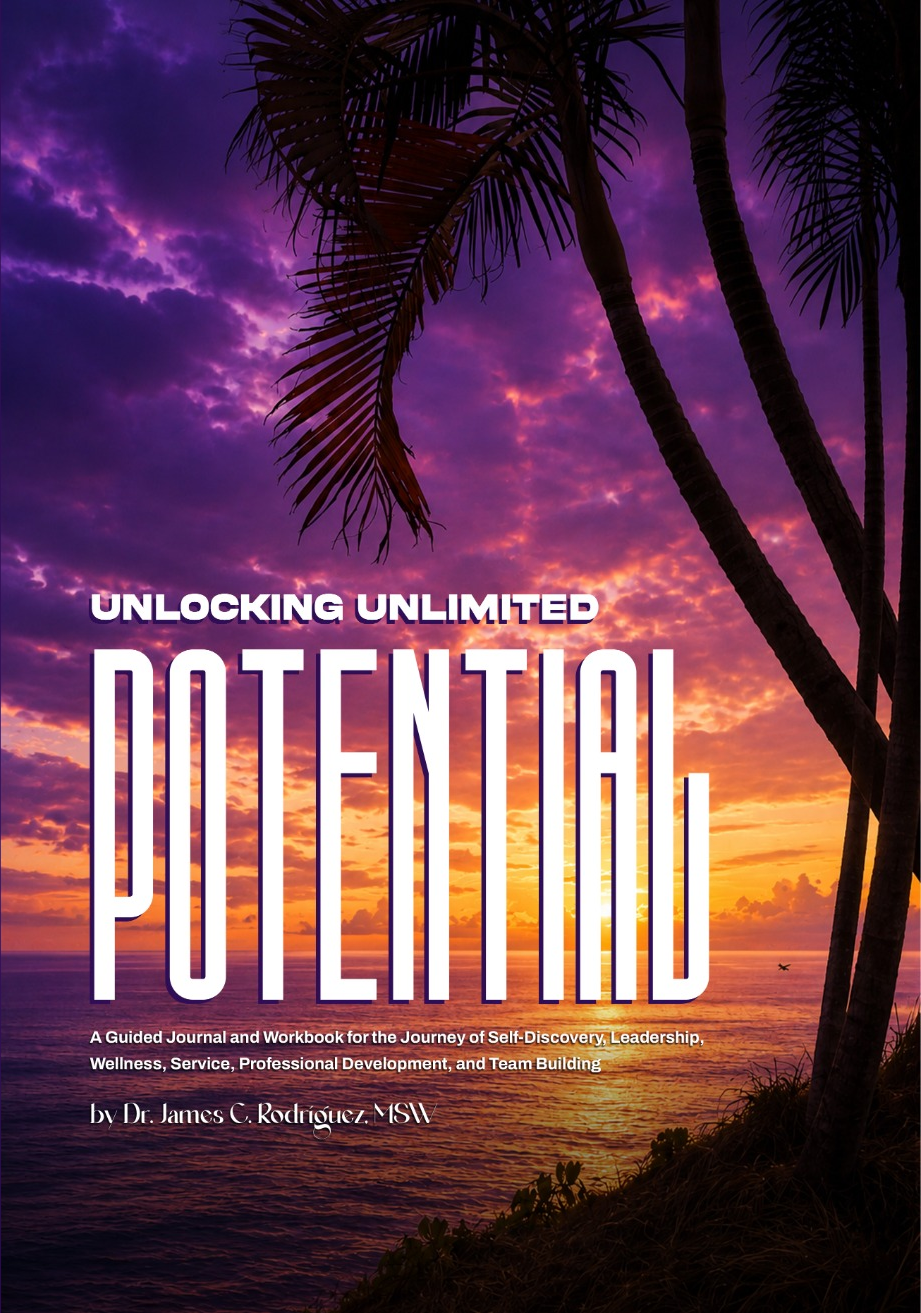
Related reflective activities and concepts are carried into Unlocking Unlimited Potential: An Evidence-Informed Reference Manual and Activity Guide for Personal Growth, Family Systems, and Professional Development by Dr. James C. Rodríguez, MSW.
Across four progressive modules and 15 signature activities, the manual invites individuals, couples, parents, caregivers, educators, coaches, practitioners, managers and leaders to explore purpose, identity, relationships, emotional intelligence, healing, leadership and lifelong growth.
These activities are not designed simply to be completed. They are meant to be experienced. Concepts become visual. Visuals become reflection. Reflection becomes application. And application creates an opportunity for meaningful change.
Never feel guilty for wanting better for your life. Becoming the difference for someone else may begin with discovering what is still possible within yourself.
Now We Move From Philosophy to Experience
So How Do We Apply It?
The Kintsugi workshop moves participants from intention and reflection into a guided, hands-on process of discovery, reframing, restoration and future application.
FFCA • Trauma-Informed Experiential Learning
The Power of Kintsugi 金継ぎ: Meaning, Purpose, Healing and Becoming Even More
At Fathers and Families Coalition of America, Kintsugi is more than a conversation about a repaired vessel. It is an invitation to slow down, reflect, examine what we carry and consider what we will intentionally carry forward.
Across FFCA learning experiences, participants explore self-awareness, emotional intelligence, behavioral patterns, relationships, meaning, purpose, resilience and leadership. Kintsugi gives those conversations a physical metaphor: a vessel, a disruption, individual pieces, intentional repair and visible lines that remind us that history does not have to be hidden for growth to continue.
The goal is not to romanticize adversity or suggest that suffering automatically produces growth. The invitation is much more human: What have I experienced? What meaning do I give it? What remains possible? And what will I do next?
Wisdom Across Cultures
Four Japanese Concepts. Four Invitations to See Life Differently.
FFCA draws thoughtfully from ideas that can expand how participants think about repair, presence, meaning and purpose. These concepts have distinct cultural histories and should not be collapsed into one philosophy or presented as clinical treatments. Together, however, they can create powerful questions for reflection.
Kintsugi — Golden Joinery
The Japanese practice of repairing broken ceramics with lacquer and highlighting the repair, often with powdered gold. The history of the object is not necessarily hidden. The repair becomes visible.
Kintsukuroi / Kintsuguroi — Golden Repair
A related term used for golden repair. For FFCA, it provides a useful reflective question: what would it mean to approach repair intentionally rather than pretending the break never occurred?
Ichigo Ichie — One Time, One Meeting
An invitation to recognize the uniqueness of an encounter. In learning, leadership and relationships, the person in front of us—and this particular moment—may never appear in exactly the same way again.
Ikigai — What Makes Life Worth Living
Broader than a career exercise, Ikigai can invite reflection on meaning, relationships, contribution, enjoyment, personal growth and the reasons we continue moving forward.
Integration Without Erasure
Human Development Does Not Belong to One Hemisphere.
FFCA's integrative approach does not require Eastern wisdom to become Western before it can contribute to learning. Nor do we treat cultural philosophy as though it automatically constitutes scientific evidence. We can respect both.
Eastern & Japanese-Informed Reflection
These traditions can invite participants to examine imperfection, repair, presence, purpose, relationship and the meaning of everyday life.
- Kintsugi / Kintsukuroi
- Ikigai
- Ichigo Ichie
- Mindful awareness
- Acceptance of imperfection and change
Western Psychological & Human-Development Frameworks
FFCA also draws from established psychological, behavioral and professional-development traditions to support structured reflection and application.
- Emotional intelligence
- Meaning-centered and existential reflection
- Cognitive and behavioral approaches
- Narrative and schema-informed reflection
- Trauma-informed principles
- Strengths, relationships and positive psychology
The question is: What can we learn, what does the evidence support, what must we represent accurately, and how can the learning be translated into healthier human action?
Emotional Intelligence in Action
Before We Repair the Vessel, We Begin Within.
The activity creates an opportunity to move emotional intelligence from a definition on a slide into intentional observation, reflection and choice.
Self-Awareness
Notice emotions, assumptions, strengths, vulnerabilities and recurring patterns without immediately judging them.
Self-Regulation
Slow down, tolerate imperfection and consider an intentional response rather than reacting automatically.
Empathy
Remember that every person may be carrying experiences that are not visible from the outside.
Relationships
Consider how our histories can influence communication, trust, boundaries, connection, service and leadership.
Evidence-Informed by Design
Ancient Metaphor. Contemporary Questions. Research-Informed Learning.
FFCA's Kintsugi experience is educational and experiential, not psychotherapy. Research does not directly validate this proprietary workshop as a clinical treatment. What the research does provide is a credible foundation for several concepts surrounding the learning experience.
Psychology Has Used the Kintsugi Metaphor Too.
The American Psychological Association has explicitly discussed Kintsugi as a metaphor for post-traumatic growth. The broader literature describes possible changes following significant struggle in areas such as relationships, personal strength, appreciation of life, new possibilities and existential or spiritual understanding.
Growth is not inevitable, and it should not be confused with simply “bouncing back.” Trauma does not have to be celebrated for the possibility of growth to be explored.
American Psychological Association: Kintsugi & Growth →Sometimes a Metaphor Can Be Seen and Touched.
A 2024 systematic review and meta-analysis examined 21 randomized controlled trials involving 868 participants studying visual arts therapies following traumatic experiences.
Arts therapies were favored over controls for positive non-PTSD outcomes, while the overall PTSD-specific result did not reach conventional statistical significance. Researchers also identified heterogeneity and called for additional standardized trials.
PubMed: Visual Arts Therapy Meta-Analysis →Putting Experience Into Language Can Matter.
A systematic review and network meta-analysis included 44 randomized trials and 7,724 adult trauma survivors examining expressive-writing approaches and comparison conditions.
Several writing approaches showed benefits relative to waiting-list conditions at follow-up, while researchers also reported heterogeneity, inconsistency and methodological limitations.
PubMed: Expressive Writing Systematic Review →Meaning Is More Than a Motivational Word.
A systematic review and meta-analysis of 66 studies involving 73,546 participants found weak-to-moderate associations between meaning in life and physical health, with stronger relationships for subjective health indicators.
Association does not establish that meaning alone causes better health. It does demonstrate that meaning is a serious area of psychological and health research.
PubMed: Meaning in Life & Physical Health →What Makes Life Worth Living?
A nationwide longitudinal study of Japanese adults age 65 and older examined Ikigai across multiple physical, psychological, social and subjective well-being outcomes. Having Ikigai was associated with several favorable subsequent outcomes, including lower psychological distress and greater happiness and life satisfaction.
The authors described Ikigai as related to, but broader than, purpose in life and emphasized that further research is needed to understand differences across populations.
Peer-Reviewed Ikigai Longitudinal Research →The Metaphor Begins With a Real Japanese Art of Repair.
Smithsonian resources describe Kintsugi as a Japanese repair technique in which lacquer is used to repair ceramics and the repaired areas may be highlighted with powdered gold. Rather than necessarily concealing damage, the repair can become part of the object's visible history.
That historical grounding matters. FFCA's human-development interpretation is an adaptation of the metaphor—not a claim that the traditional Japanese craft itself was developed as psychotherapy.
Smithsonian: The Beauty of Broken Objects →The Experiential Journey
Breaking Insights to Build Masterpieces
The ceramic object is never the destination. It is a physical anchor for deeper reflection about awareness, relationships, meaning, resilience, purpose, possibility and intentional action.
Setting Intention
The Empty Vessel
Before anything changes, participants pause to recognize what is already present: experiences, strengths, relationships, wisdom, values, unfinished questions and possibilities.
The Break
Making Space for Vulnerability
Under facilitator guidance and appropriate safety procedures, the physical object is separated into pieces. Participants pause before trying to repair anything.
The Discovery
Insights Within the Pieces
Participants examine the fragments and consider memories, relationships, decisions, strengths, lessons or unfinished stories that the pieces may symbolically represent.
The Reframe
Choosing the Gold
Participants identify qualities, values, relationships and sources of meaning that can symbolically become part of their repair: courage, boundaries, compassion, wisdom, forgiveness, faith, service, love or something uniquely their own.
The Creation
Restoration in Progress
Participants begin guided reassembly in an environment that encourages patience and reflection rather than speed or perfection.
Narrative Reclamation
Seeing the Story Differently
Participants move from the repaired object back into language. Journaling and reflection provide an opportunity to identify strengths, meaning, relationships and future possibilities differently.
Integration & Future Vision
Kintsugi as a Living Practice
Reflection moves toward application. Participants identify intentional next steps for personal life, relationships, professional practice or leadership.
Dignity • Choice • Autonomy
Trauma-Informed Means Choice Matters.
This is an educational and reflective experience, not psychotherapy. Participants should never be required to publicly disclose traumatic experiences. Reflection and sharing remain invitational. Facilitators establish physical and emotional safety expectations, and participants can step back when needed.
The goal is not forced vulnerability. The goal is meaningful learning with dignity, autonomy and respect.
The FFCA Developmental Lens
Impact. Influence. Inspiration.
Personal development becomes even more meaningful when awareness begins influencing relationships, families, professional practice, leadership and community.
What Changes Within Me?
What have I discovered about my emotions, experiences, strengths, values, relationships, patterns and possibilities—and what am I willing to do differently?
What Do Others Experience Because of Me?
Parents influence children. Practitioners influence families. Educators influence learners. Supervisors influence teams. Leaders influence culture.
What Possibility Can My Growth Awaken in Someone Else?
Inspiration is not perfection. Authenticity, courage, compassion and purposeful action can help another person imagine possibilities for their own journey.
Meaning Beyond the Repair
Ikigai 生き甲斐: What Makes Life Worth Living?
Within FFCA learning experiences, Ikigai is not reduced to a trendy four-circle career diagram. We use it as an invitation to consider meaning, relationships, contribution, interests, growth, satisfaction and the reasons a person continues moving forward.
Once we have reflected on what was broken, changed, repaired, learned or carried, another question becomes possible:
What is worth moving toward now?
The Noological Dimension
Beyond “What Happened to Me?” Toward “What Will I Live For?”
FFCA's noological dimension brings meaning, values, responsibility, purpose and transcendence into the developmental conversation.
The question is not whether adversity was good. It may not have been. Nor does meaning erase grief, injustice, loss or pain. Instead, meaning-centered reflection asks whether a human being can still choose a response, identify a value, serve something beyond the self and determine what will be carried forward.
From Reflection to Movement
Motivation Goes Beyond Momentary Momentum. It Moves the Needle.
Potential Learning Impact
One Vessel. One Person. A Potential Ripple Across Relationships and Systems.
These represent intended areas of learning and reflection, not guaranteed clinical outcomes.
Individual
Self-awareness, meaning-making, emotional vocabulary, reflection on strengths, self-compassion and intentional next steps.
Relationships & Family
Reflection on empathy, communication, boundaries, forgiveness, connection and how personal experiences influence relationships.
Practice & Leadership
Greater awareness of how assumptions, emotions, experiences and responses may influence decisions, service, supervision and teamwork.
Organization & Community
Conversations about psychological safety, repair, accountability, belonging, culture and how systems respond when people encounter challenge or change.
Take the Reflection With You
The Workshop May End. The Journey Does Not Have To.
Themes explored through Kintsugi—including healing, boundaries, meaning, self-awareness, relationships, intentional growth and purpose—connect with guided activities contained in Unlocking Unlimited Potential: An Evidence-Informed Reference Manual and Activity Guide for Personal Growth, Family Systems, and Professional Development by Dr. James C. Rodríguez, MSW, CADC.
The manual contains four progressive modules and 15 guided activities addressing self-discovery, meaning, relationships, emotional intelligence, leadership, healing, vision and lifelong growth.
Experience • Learn • Bring It Home
Don't Just Read About the Experience. Decide How You Want to Enter It.
Kintsugi-informed experiential learning is incorporated across FFCA professional-development experiences and can also be integrated into customized organizational learning.
Experience an FFCA Training
Explore FFCA's Advanced Practitioner Credential™, OAR Leadership Institute™, DiSC learning experiences and additional professional-development pathways.
Explore FFCA Trainings →Bring Kintsugi to Your Organization
Incorporate Kintsugi-informed experiential learning into customized professional development, leadership, team development, parent education or family-strengthening institutes.
Connect With FFCA →Continue With the Manual
Extend reflection through the evidence-informed, facilitator-guided activities in Unlocking Unlimited Potential.
Purchase the Manual →Explore the Evidence Yourself
Research, Cultural Context & Further Reading
FFCA encourages practitioners, educators, leaders and participants to examine authoritative and original sources rather than relying solely on summaries. Explore the literature informing several concepts represented in this learning experience.
People • Purpose • Possibilities • Even More
The Gold Was Never Just in the Vessel.
The vessel gives us something to hold. The repair gives us something to see. Reflection gives us something to examine. Meaning gives us something to pursue.
Impact begins within. Influence moves outward. Inspiration helps another person imagine possibility. Ikigai asks why the journey is worth continuing. Transcendence asks who might benefit because we continued it.
Honor the journey. Discover the gold. Decide what you will carry forward. Then become even more.


From Reflection to Restoration
Building Bridges from Broken Pieces
Kintsugi gives us a physical object to hold, but the deeper experience is not really about the ceramic vessel. It is about the human being holding it.
Through guided reflection, hands-on experiential learning, journaling and intentional restoration, participants are invited to examine how life experiences can influence the ways we see ourselves, connect with others, parent, teach, serve, practice, supervise and lead.
The experience does not ask participants to celebrate pain or pretend every difficult experience made them stronger. Instead, FFCA creates space for another possibility: acknowledging what has happened while discovering what may still be possible.
Hands-On • Reflective • Experiential
The Heart-Shaped Vessel Becomes a Mirror for Reflection
Participants work with a ceramic heart-shaped vessel and guided repair materials as part of a structured learning experience. The physical process becomes a metaphor through which participants can explore meaning, relationships, resilience, values and intentional growth.
The Vessel
Before anything is changed, participants notice what is already present and reflect on the experiences, strengths, relationships, values and wisdom they already carry.
The Break
The physical object changes. Participants pause before immediately attempting to repair it and observe their thoughts, emotions and responses without assigning a predetermined meaning.
The Gold
Participants determine what their own symbolic gold may represent: courage, compassion, wisdom, faith, boundaries, forgiveness, support, love, purpose or something uniquely meaningful to them.
The Restoration
The pieces are intentionally reassembled. The process encourages patience, reflection and acceptance that repair does not necessarily mean returning something to exactly what it was before.
The Reflection
Journaling and optional sharing move the experience from the physical object back to the participant: What have I discovered? What matters now? What do I want to carry forward?
The Application
Insight becomes an action plan. Participants consider how the learning may influence personal life, relationships, parenting, professional practice, teamwork or leadership.
Narrative Reclamation
The Repair Is Visible. So Is the Possibility.
Participants may capture their reflection privately in a journal, create a short personal display card, or share with others when they choose to do so.
Sharing is invitational. Vulnerability is never the price of participation.
FFCA • Becoming Even More
The Goal Is Not Perfection. The Invitation Is Possibility.
“Even more” does not mean that adversity was necessary, deserved or beneficial. It means that our history does not have to represent the limit of who we may still become.
Even More Present
I can notice what is happening within and around me with greater awareness and intentionality.
Even More Resilient
I can identify strengths, resources, relationships and choices available to me when life becomes difficult.
Even More Precious
My worth is not determined by whether my history, relationships or journey have been flawless.
Even More Possible
My past is part of my story without having to determine the entirety of my future.
Reflection With Direction
The Kintsugi Philosophy Assessment
Reflection can become more useful when participants have a structure for considering what they have discovered. The FFCA Kintsugi Philosophy Assessment provides an educational self-reflection across four developmental areas.
The assessment is not a clinical diagnostic instrument. It is designed to help participants organize reflection, identify areas for continued development and translate insight into an intentional personal action plan.
Self-Acceptance
How do I relate to my own history, strengths, imperfections and humanity?
Personal Growth & Worth
Where do I recognize value within myself, and where do I still see opportunities to grow?
Resilience & Coping
What internal and external resources help me navigate challenge, change and adversity?
Mindfulness & Presence
How intentionally am I noticing my emotions, thoughts, relationships and responses in the present moment?
Insight → Intention → Action
The Experience Ends With a Decision.
Participants use their reflections to identify an intentional next step. That action may involve a conversation, a boundary, a relationship, a parenting decision, a leadership practice, seeking additional support, reconnecting with purpose or simply creating space for continued reflection.
The action belongs to the participant. The facilitator's role is not to prescribe someone's meaning but to create conditions in which meaningful reflection and intentional choice can occur.
One Experience • Multiple Applications
The Questions Change Depending on Who Is Holding the Vessel.
The Kintsugi experience can be facilitated across FFCA learning environments while adapting reflection and application to the participants, setting and learning goals.
Individuals
Self-awareness, values, meaning, personal growth, boundaries and future direction.
Parents & Caregivers
How personal history may influence parenting, relationships, emotional availability and what we model for children.
Couples & Relationships
Communication, empathy, repair, boundaries, connection and how two histories enter one relationship.
Frontline Professionals
Self-awareness, empathy, boundaries, reflective practice and the human experience of serving others.
Educators
Presence, relationships, assumptions, compassion and the influence adults have on learning environments.
Head Start & Family Services
Reflective family engagement, parent partnerships, staff development and relationship-centered practice.
Teams
Trust, empathy, authenticity, repair, communication, belonging and collective responsibility.
Leaders & Executives
Emotional intelligence, self-awareness, culture, psychological safety, accountability and how leadership is experienced by others.
Building Bridges from Broken Pieces
The Repaired Vessel Is Not the Final Destination.
The deeper invitation is to consider how what we discover within ourselves can influence the relationships, families, classrooms, programs, teams, organizations and communities around us.
Individual
Reflection on self-awareness, self-acceptance, emotional patterns, meaning, strengths and intentional growth.
Relational
Greater curiosity about communication, empathy, connection, boundaries, repair and how our experiences influence other people.
Professional
Reflection on how personal assumptions, emotional responses and lived experiences can influence practice, teamwork, supervision and leadership.
Organizational & Community
Conversations about belonging, psychological safety, accountability, repair, resilience and cultures that recognize the humanity of the people within them.
Closing With Compassion
From Compassion Inward to Compassion Outward
When appropriate to the learning environment, FFCA may close the experience with an optional loving-kindness or compassion-focused mindfulness practice.
The intention is simple: after examining something personal, participants are invited to slow down, extend compassion inward and consider how empathy and compassion might also extend toward the people around them.
Impact • Influence • Inspiration • Meaning
What Will You Build From the Pieces You Carry?
Building bridges from broken pieces is not about pretending everything can be repaired exactly as it was. Some experiences change us. Some require boundaries. Some require support. Some remain unfinished.
Kintsugi gives us another way to ask the question: Can we acknowledge what has happened, recognize what remains, discover what matters and intentionally decide what we will carry forward?
The answer may influence more than one individual. It may influence a child, a partner, a family, a classroom, a client, a colleague, a team, an organization or a community.
Discover the gold. Honor the journey. Build the bridge. Become even more.