
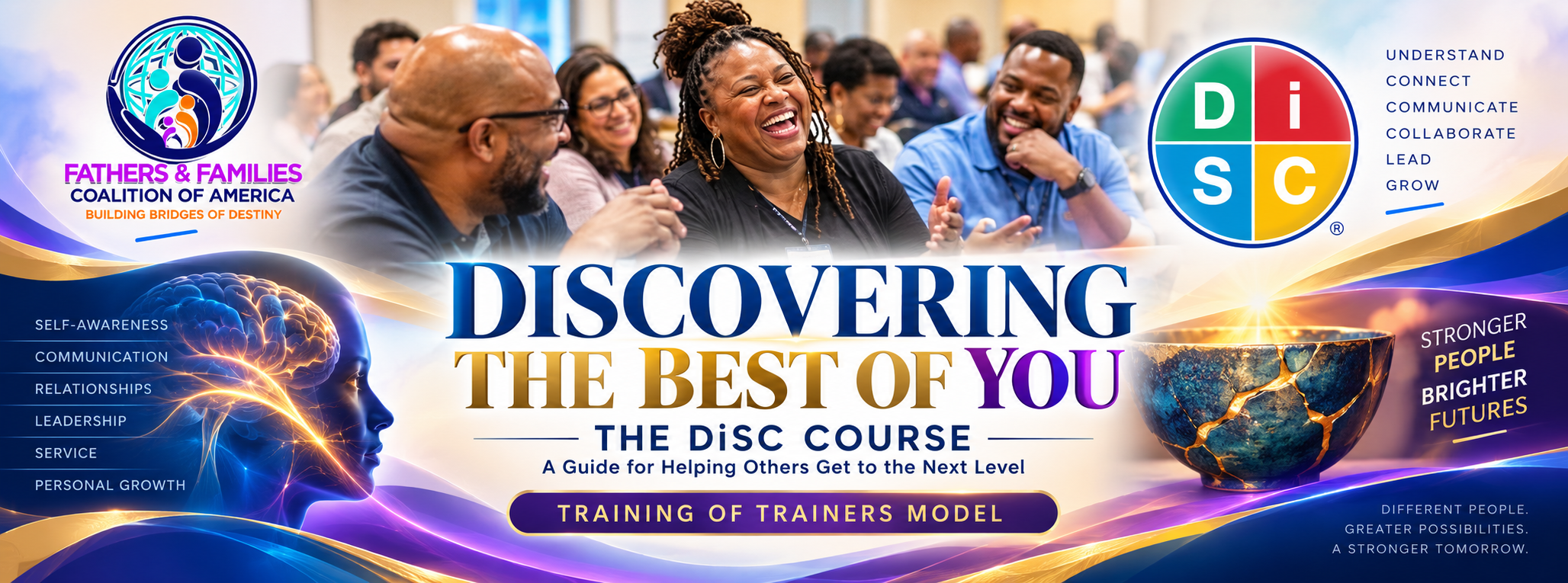
Discovering the Best of You— and Learning How to Help Others Get to Their Next Level.
The FFCA DiSC Model Service Framework begins with behavioral insight, but it does not end with a personality profile. It creates an experiential learning journey connecting self-awareness, communication, emotional intelligence, relationships, purpose, resilience, leadership and real-world application.
The question is not simply, “What is my DiSC style?” The deeper questions are: What do I understand about myself? How do other people experience me? What happens when I am under pressure? How can I adapt without losing who I am? And how can greater understanding help me become more effective in my family, profession, team, organization and community?
FFCA integrates behavioral awareness with emotional, relational, reflective and purpose-centered learning so that insight has somewhere meaningful to go.
Understanding Behavior Is Only the Beginning.
A behavioral framework becomes more useful when participants can translate insight into everyday interactions. FFCA uses DiSC as a practical map for exploring six interconnected areas of human and professional development.
Recognize behavioral tendencies, preferences, communication patterns, strengths and potential blind spots.
Examine how pace, tone, priorities and behavioral differences influence how messages are delivered and received.
Use behavioral insight to strengthen empathy, trust, listening, boundaries and interpersonal understanding.
Consider how personal style influences decision-making, delegation, conflict, motivation and leadership presence.
Adapt engagement when working with parents, families, colleagues, participants and communities.
Move from simply naming a style toward reflection, intentional adaptation and continued development.
Different Does Not Mean Difficult. Different Means Different.
DiSC provides language for recognizing differences in observable behavioral tendencies. The value is not putting people into four boxes. The value is developing another lens for understanding why people may communicate, respond, prioritize and approach relationships differently.
FFCA teaches participants to use behavioral information as a starting point for curiosity—not as a diagnosis, stereotype or explanation for everything a person does.
Consider pace, challenge, results, decisiveness and direct communication.
Consider expression, interaction, enthusiasm, connection and persuasion.
Consider consistency, support, patience, collaboration and stability.
Consider accuracy, standards, analysis, structure and attention to quality.
Behavior Is Visible. The Human Being Behind the Behavior Is More Complex.
FFCA expands the conversation beyond observable style by inviting participants to consider multiple dimensions that can influence how people communicate, relate, respond and lead. DiSC remains one behavioral lens within a larger developmental experience.
Beliefs, assumptions, interpretation, perception, coping patterns and the stories we tell ourselves.
Emotional awareness, regulation, empathy, triggers, relational sensitivity and presence.
Observable communication, action, adaptability, habits and interaction patterns.
Purpose, values, responsibility, meaning, direction and the question of what our lives and leadership are ultimately serving.
Three Questions Move the Learning Beyond a Profile.
What Happens Because of the Way I Show Up?
Behavioral insight invites participants to examine the consequences of communication, decision-making, listening, conflict and leadership behavior.
How Do Other People Experience My Presence?
Leadership is not limited to titles. Parents, practitioners, colleagues, supervisors and community members influence others through everyday interactions.
What Becomes Possible When Understanding Creates Growth?
Greater awareness can create opportunities to communicate differently, repair relationships, strengthen teams and help other people discover their own possibilities.
Because Understanding Behavior Without Exploring Meaning Leaves Part of the Human Story Untouched.
FFCA intentionally brings behavioral and psychological frameworks into conversation with selected philosophies of meaning, purpose, resilience and human development. They are not presented as interchangeable theories. Each provides a different reflective lens.
From “How Do I Behave?” to “What Gives My Life Direction?”
Ikigai introduces questions of meaning, purpose, contribution, personal growth and the roles that give life a sense of value.
Within FFCA learning, it creates space to connect behavioral awareness with questions such as: What matters to me? What am I becoming? Where can my strengths contribute? What kind of life and leadership am I building?
Growth Does Not Require Pretending We Were Never Broken.
Kintsugi—the Japanese practice of repairing broken pottery while making the repair visible—provides FFCA with a powerful reflective metaphor.
Rather than treating adversity, mistakes or lived experience only as deficits to hide, participants can consider how experience may inform resilience, self-understanding, empathy, healing and future action. Kintsugi is used as a developmental metaphor, not as a clinical treatment or diagnosis.
No Single Theory Explains a Human Being.
Discovering the Best of You draws upon Dr. James C. Rodríguez's broader professional-development work to create an integrative learning environment. These concepts are used as complementary lenses rather than as a claim that one framework proves another.
Learn It. Experience It. Apply It. Help Others Grow.
Understanding your own profile is valuable. The FFCA Training of Trainers experience goes further by helping participants understand the learning process behind behavioral insight and consider how DiSC-informed concepts can be used appropriately in professional-development, leadership, team, family and community-learning environments.
What You Take With You Is Greater Than a Communication Class.
Participants are not simply introduced to four letters. The learning experience is designed to help people understand themselves, examine relationships, strengthen communication, connect behavior with emotional awareness and purpose, and consider how those insights can be transferred into everyday practice.
Different Rooms. Different Roles. The Same Human Need to Understand and Be Understood.
Communication, relationships, self-awareness and family interaction.
Workplace communication, collaboration and professional presence.
Adaptability, decision-making, influence and relational leadership.
Supervision, communication, team differences and organizational culture.
Engagement, empathy, communication and reflective practice.
Shared language, collaboration, conflict awareness and trust.
Interactive professional development for diverse learning audiences.
Customized learning that can be integrated into broader workforce-development initiatives.
Research Gives Us Reasons to Look Beyond Behavior Alone.
FFCA does not claim that research on DiSC, purpose, meaningful work or resilience independently validates every component of the FFCA model. Instead, relevant research helps explain why an integrative professional- development approach is worth exploring.
DiSC has been incorporated into professional leadership and communication curricula as a structured way to examine how people communicate within teams and perceive differences in communication style.
Research on meaningful work has found substantial relationships with work engagement, organizational commitment and job satisfaction, supporting the value of asking not only how people work, but what gives their work meaning.
Contemporary reviews describe Ikigai in relation to life satisfaction, personal growth, social role, purpose and well-being—dimensions that broaden reflection beyond behavioral preference.
Emerging research has examined Kintsugi-based experiential work as a context for meaning-making, acceptance, values-based reflection and psychological flexibility. FFCA uses Kintsugi as a reflective metaphor.
Organizational scholarship increasingly examines how meaningful work and purpose relate to employee experience, engagement and the sense that one's contribution matters.
FFCA brings complementary ideas into a facilitated environment so participants can compare, reflect, practice and decide what is useful within their own lives and professional roles.
The FFCA Model Was Built Across Disciplines, Not Around a Single Assessment.
Led by Dr. James C. Rodríguez, MSW, CADC, Discovering the Best of You reflects an evolving integration of behavioral assessment, clinical social-work practice, coaching, family systems, father and family engagement, leadership development, adult learning and organizational training.
Dr. Rodríguez's professional-development preparation has included DiSC trainer development, transformational coaching, life coaching, Ikigai coaching, Motivational Interviewing, emotional intelligence, trauma-informed approaches, schema-informed practice and leadership-development study, including The John R. Wooden Course.
FFCA DiSC Training of Trainers at HOPE 2027
Thursday, April 15, 2027 provides another opportunity to invest in professional development, practical application, assessment tools, Train-the-Trainer resources, networking and learning that participants can carry forward after the conference.
Understand Behavior. Improve Communication. Strengthen Relationships.
The bundled registration includes FFCA Training of Trainers instruction, training materials, assessments, participant resources, applied exercises and supporting learning materials.
Bring the Learning Into Your Organization.
FFCA can adapt DiSC-informed learning within broader professional-development and capacity-building experiences. An organization does not have to fit itself into a conference course. The learning experience can be designed around its people, priorities and intended outcomes.
Communication, self-awareness, teamwork, engagement and professional relationships.
Behavioral insight integrated with emotional intelligence, purpose, communication and leadership application.
Adapt appropriate concepts for relationships, communication, self-awareness and family engagement.
Apply behavioral insight to supervision, team development and organizational communication.
Build facilitator confidence and help appropriate learning continue beyond a single training event.
Integrate DiSC-informed learning with selected FFCA leadership, family, practitioner and capacity-building frameworks.
Discovering the Best of You Is Not About Becoming Someone Else.
It is about understanding yourself well enough to become more intentional about how you communicate, how you respond, how you build relationships, how you lead and how you contribute to the lives of other people.
A behavioral profile can begin the conversation. Reflection can deepen it. Emotional intelligence can humanize it. Purpose can give it direction. Practice can turn it into behavior. Facilitation can help the learning reach someone else.
The goal is not to leave knowing four letters.
The goal is to leave knowing more about yourself,
understanding more about others, and carrying practical
possibilities for communicating, serving and leading
differently.
That is Discovering the Best of You.
That is the FFCA DiSC Training of Trainers experience.
You Are Not Coming Just to Learn DiSC. You Are Coming to Learn How to Create Learning.
Participants will experience the DiSC framework personally, practice applying it with others, and explore selected facilitation approaches drawn from FFCA's broader professional development ecosystem. The goal is not simply knowing more. It is developing greater confidence in helping other people learn, reflect, communicate and grow.
Experience DiSC Before You Facilitate It
You will explore behavioral styles, communication patterns, differences in pace and priorities, interpersonal dynamics and adaptation. Then you will move from participant to practitioner—practicing how these concepts can be explained, discussed and applied with other people.
Learn to Facilitate a Community of Truth
Drawing from Parker J. Palmer's The Courage to Teach and his Community of Truth framework, participants will examine an approach to learning in which the facilitator is not simply the person in the room who possesses all the answers. The learning community gathers around a meaningful subject, allowing experience, inquiry, dialogue and reflection to contribute to understanding.
Explore What May Be Happening Beneath the Behavior
Selected cognitive-processing concepts from FFCA's Advanced Practitioner Credential™ help participants consider how perception, interpretation, beliefs and internal processing can influence outward behavior. DiSC describes useful behavioral tendencies; cognitive reflection encourages us to ask what else may be influencing the interaction.
Replace the Urge to Tell With the Capacity to Listen
Selected Motivational Interviewing principles introduce participants to a collaborative way of engaging others. Rather than assuming that effective facilitation means supplying every answer, participants explore listening, curiosity, autonomy, engagement and questions that can help people articulate their own motivations for change.
Notice Before You React
Selected mindfulness practices from the Advanced Practitioner Credential™ add another dimension to behavioral awareness: the capacity to notice thoughts, emotions and reactions before automatically acting upon them. For facilitators and leaders, presence can be as important as presentation.
Connect Behavior, Emotion, Thinking, Meaning and Purpose
Participants are invited to connect DiSC with emotional intelligence, cognitive reflection, purpose, lived experience, communication and human relationships. The result is not a claim that one model explains the whole person. It is a richer collection of lenses for understanding ourselves and engaging other people more thoughtfully.
Come for DiSC. Leave With a Larger Understanding of People.
There are many places where you can take a personality assessment. There are many courses that can teach you the definitions of D, i, S and C. That is not where we intend to stop.
At FFCA, you will be asked to experience the learning personally and then consider how to carry it responsibly into your work with others. You will explore behavior. You will practice communication. You will examine how people process information. You will experience elements of Motivational Interviewing and mindfulness. You will consider Palmer's Community of Truth and what it means to facilitate learning rather than merely deliver information.
Most importantly, you will be reminded that behind every assessment result is a human being—a parent, colleague, practitioner, leader, family member or community participant carrying experiences, emotions, values, relationships, strengths and possibilities that cannot be reduced to four letters.
That is why this is more than DiSC training. It is an opportunity to strengthen the person, develop the practitioner, prepare the facilitator, and expand the capacity to help other people discover the best of themselves.
Thursday, April 15, 2027 • HOPE 2027 • Hilton Los Angeles Airport
FFCA DiSC Training of Trainers • $140 bundled learning experience