Developing People. Strengthening Practice. Transforming Communities.
What if professional development did more than give you something new to know—and helped you discover something new about who you are, how you lead and how you serve?
The Advanced Practitioner Credential™ is an evidence-informed, interdisciplinary professional-development framework connecting human development, emotional awareness, behavior, relationships, resilience, meaning, family systems, leadership, motivational engagement, wellness and applied professional growth.
Participants are invited to move from knowledge → reflection → experience → application, examining not only what they know, but how that knowledge influences the way they engage people, families, teams, organizations and communities.
The Advanced Practitioner Credential™ Model
Human beings do not experience life, relationships or professional practice in separate compartments. APC examines interconnected dimensions that influence how people think, feel, behave, relate, find meaning and translate learning into practice.
Thinking, perception, values, beliefs, learning, self-awareness, decision-making and the relationship between what we understand and how we respond.
Emotional awareness, empathy, self-regulation, interpersonal understanding, relationship health and the emotional presence we bring to others.
Patterns, choices, communication, habits, motivation, resilience and practical behaviors influencing professional and family relationships.
Meaning, purpose, responsibility, values, direction, legacy and the human capacity to choose how we respond to adversity and possibility.
What Participants Explore
APC intentionally connects personal development with professional practice—examining what happens within us, between us and throughout the systems and communities in which we work.
Emotional awareness, self-regulation, empathy, interpersonal understanding and emotional presence.
Safety, dignity, relationships, reflection and understanding adversity without reducing people to what has happened to them.
Relationship-centered approaches for engaging parents, fathers, caregivers and families as strengths and partners.
Engagement, listening, autonomy, ambivalence and communication supporting people in identifying their own pathways toward change.
Purpose, character, responsibility, influence, service, relationships and decision-making.
Stress, adversity, boundaries, healing, perseverance, responsibility and sustainable approaches to service.
Personality, communication, expectations, social connection and behavioral influence.
Values, responsibility, direction, purpose and the legacy created through our choices.
Guided activities, discussion, reflection, experiential practice and tools that move learning beyond the classroom.
Eleven Modules. One Integrative Practitioner Experience.
The formal APC learning architecture spans eleven interconnected areas of professional development.
Evidence-Informed. Interdisciplinary. Human-Centered.
APC does not ask one theory, one assessment or one professional discipline to explain the complexity of a human life. The model integrates complementary concepts and approaches so participants can examine human development and professional practice from multiple perspectives.
Intellectual Influences
Its intellectual development has been influenced by the work of nationally and internationally recognized scholars, clinicians, researchers and educators, including Drs. William Miller and Stephen Rollnick, Dr. Albert Ellis, Dr. Viktor Frankl, Professor Emerita Maria Napoli, Dr. Ross Parke, Dr. Martin Seligman, Dr. Jay Fagan, Dr. Jessica Pearson and Dr. Ronald Mincy.
APC Model Contributors
The model has also benefited from the intellectual contributions of Dr. Obie Clayton, Professor Emeritus Edwin Gonzalez-Santin, Dr. Bakahia S. Madison, Dr. Narviar Barker and Dr. Dezette Johnson.
A Framework Built for Serious Professional Learning
The Advanced Practitioner Credential™ has been developed as an applied professional-development experience rather than a passive information course. Learning can include cognitive, affective and experiential methods, guided activities, case application, reflection, practicum work and competency-focused professional development.
FFCA's professional-development work has been used across higher education, family and father engagement, Head Start and early childhood environments, public systems, behavioral health, community organizations and interdisciplinary professional settings.

A Professional Resource You Don't Leave in the Training Room.
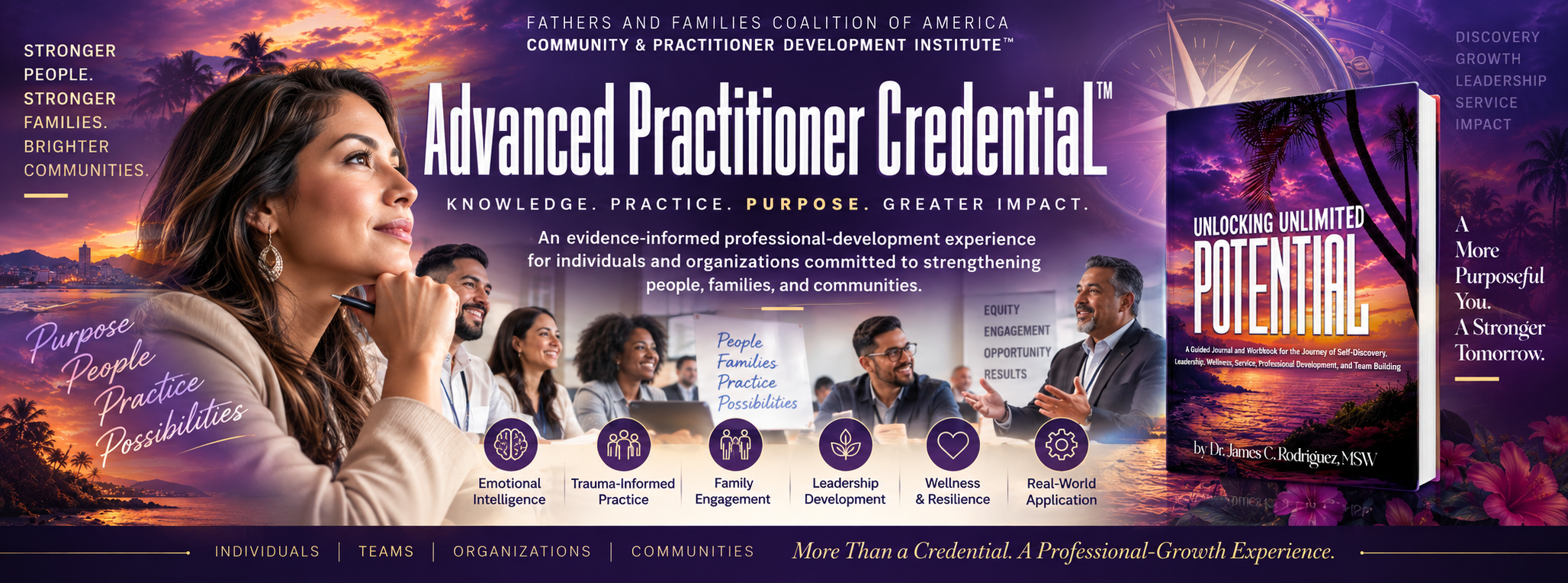
Unlocking Unlimited Potential: An Evidence-Informed Reference Manual and Activity Guide for Personal Growth, Family Systems, and Professional Development
The manual provides a tangible learning spine for reflection, guided application and continuing personal and professional development. It is not simply a book to read.
Exercises, visual models, assessments, reflective journals, relationship activities, future visioning, values exploration, leadership applications and action-planning tools create opportunities for participants to engage the learning long after a facilitated session ends.
Where the Credential and the Manual Intersect
The four modules within Unlocking Unlimited Potential do not replace APC's eleven-module professional curriculum. They provide complementary reflective and experiential tools that can deepen selected dimensions of the credential experience.
Intersects with APC learning related to integrative frameworks, goal setting, mindfulness, self-awareness, reflection, purpose and professional direction.
Intersects with behavioral awareness, DiSC-informed reflection, goal development, mindfulness, culture, resilience and examination of personal and professional identity.
Intersects with healthy father and family involvement, emotional intelligence, motivational engagement, culturally responsive practice, relationships and leadership.
Intersects with trauma-informed practice, motivational engagement, reflective practice, evaluation of one's own practice and continuing professional development.
Learning Becomes More Powerful When People Can Do Something With It.
Ideas become easier to explore through models, activities and guided learning.
Participants connect concepts to their own experiences, relationships and professional practice.
Insight begins moving toward choices, communication, behavior and practical action.
Continued practice creates opportunities for meaningful individual, family, team and organizational change.
Experience the Advanced Practitioner Credential™ at HOPE 2027
Join FFCA on Monday, April 12, 2027 during the 28th International Families & Fathers Conference for a concentrated, facilitator-guided APC professional-development experience.
The Institute connects knowledge, self-reflection, relationships, leadership, human development and practical application—and is designed to be accessible to both in-person and virtual participants.
This experience is about more than adding another credential. It is an opportunity to examine how you understand yourself, engage others, build relationships, respond to adversity, facilitate growth and translate professional knowledge into meaningful practice.
What If You Could Bring This Learning to Your Entire Organization?
You do not have to send everyone to FFCA. FFCA can bring the learning to you and work with your organization to align professional development with your people, priorities and desired outcomes.
Family engagement, relationships, wellness, leadership and family-strengthening applications.
Applied learning for frontline professionals, educators, parent educators and interdisciplinary teams.
Professional learning for supervisors, emerging leaders, executives and organizational teams.
Customized experiences connecting leadership, organizational priorities, implementation and capacity.
Three Roads. One Direction.
Invest in People. Strengthen Practice. Build Sustainable Capacity.
Begin independently with Unlocking Unlimited Potential and use the resource for continued reflection, growth, relationships, purpose and professional development.
Move into facilitator-guided professional development where reflection, discussion, experiential learning, application and human connection bring the concepts to life.
Build professional learning around your organization's people, goals, environment and desired outcomes—and create pathways for the learning to continue.
We Don't Have to Stop When the Training Ends.
A course can create knowledge. A powerful learning experience can create reflection and momentum. Sustainable professional development asks a larger question: What happens after participants leave the room?
Depending upon the scope of an organizational engagement, FFCA can extend professional development beyond initial delivery into implementation support, co-facilitation, internal champion development, coaching, reflection, evaluation, adaptation and sustainability planning.
The goal is not organizational dependency on an outside trainer. The opportunity is to strengthen the people, confidence and internal capacity capable of carrying meaningful learning forward.
Who Can Benefit?
APC is designed for people who work with people—and for organizations committed to strengthening those who serve families and communities.
Where You Begin Is Your Choice. What You Build From the Learning Is the Opportunity.
Invest in yourself. Experience the credential. Bring the learning to your organization. Build capacity that continues.
IMPACT → INFLUENCE → INSPIRATION → SUSTAINABILITY
Why Develop the Whole Person When Your Organization Needs Better Performance?
Because the person who communicates with a parent, supervises an employee, facilitates a meeting, responds to conflict, makes a referral, teaches a class, manages a crisis or leads a department does not leave their emotions, beliefs, communication patterns, relationships, experiences and sense of purpose at the door.
Professional knowledge matters. Technical competence matters. Policies, procedures and credentials matter. But organizations ultimately deliver their mission through human beings working with other human beings.
The Affective & Cognitive, Emotional, Behavioral and Noological pillars create an integrated learning framework for examining how people think, feel, communicate, behave, relate, find meaning, make decisions, respond under pressure and translate professional knowledge into human interaction.
These Pillars Do Not End With the Individual.
Each dimension can influence communication, supervision, engagement, leadership, teamwork and the experience families and communities have with an organization.
How People Think Shapes How They Practice.
Beliefs, assumptions, interpretation, values and decision-making influence how staff understand families, coworkers, conflict, responsibility and possibility.
Organizational relevance: reflective judgment, reduced automatic assumptions, stronger problem-solving, intentional decision-making and greater awareness of how personal perspectives influence professional practice.
How People Regulate Themselves Shapes How Others Experience Them.
Family-serving and human-service environments can involve stress, disagreement, urgency, trauma histories and emotionally difficult conversations.
Organizational relevance: emotional awareness, empathy, self-regulation, relationship management and a stronger capacity to remain present when interactions become difficult.
Organizational Culture Is Experienced Through Behavior.
Mission statements do not interact with families. People do. Communication habits, listening, follow-through, adaptability and interpersonal behavior influence whether organizational values are actually experienced.
Organizational relevance: communication, engagement, accountability, collaboration, motivational practice and the translation of learning into observable professional behavior.
Purpose Helps Connect the Job to the Mission.
People can know what they are supposed to do without remaining connected to why the work matters. Meaning, values, responsibility and purpose create another dimension of professional development.
Organizational relevance: mission connection, responsibility, values-based leadership, reflection on professional purpose and consideration of the legacy created through everyday service.
What Changes When More of the Organization Shares the Learning?
Organization-wide professional development can create opportunities for people across roles to develop shared concepts, language and practices rather than leaving learning isolated within one department or one employee.
Staff examine their own patterns, assumptions, communication and professional presence.
Teams develop language for understanding differences, listening, conflict and interpersonal interaction.
Professional learning connects human behavior, empathy, motivation and relationship-centered practice.
Supervisors and staff can reference common concepts during coaching, reflection and implementation.
Leaders can connect accountability with reflection, communication, development and continuous improvement.
Training can become part of implementation, coaching, internal champion development and organizational capacity building.
From Head Start Programs to Public Systems
The value of an integrative model becomes clearer when professional development is considered within the realities of organizations serving parents, children, families and communities.
One Mission. Many Professional Roles.
A Head Start or early-childhood organization may bring together managers, directors, family-service professionals, parent educators, teachers, leadership teams and other staff whose responsibilities differ but whose work intersects around children and families.
APC-related professional development can be adapted for pre-service learning, managers and directors institutes, parent and family engagement, leadership development, staff development and interdisciplinary professional learning.
- Human behavior and communication
- Emotional intelligence and professional presence
- Trauma-informed and relationship-centered practice
- Parent and father engagement
- Motivational conversations
- Cultural humility and responsive practice
- Leadership, supervision and team development
- Reflection and continuous professional growth
Move From Training Activity to Measurable Capacity.
FFCA's proposed Oklahoma capacity-building architecture illustrates a broader systems approach: strengthen the people receiving services while simultaneously developing the professionals, leaders and internal champions responsible for sustaining meaningful engagement.
That approach can incorporate discovery, customization, facilitated learning, co-design, action planning, implementation support, internal champion development, evaluation and sustainability.
- Professional confidence and reflective practice
- Communication and engagement skills
- Leadership and advisory capacity
- Action-plan development and follow-through
- Implementation observation and feedback
- Internal champion readiness
- Continuous quality improvement
- Sustainability beyond the consultant
The Strategic Opportunity Is Shared Learning.
When one employee attends professional development, that individual may return with valuable knowledge. When teams and leaders participate in a coordinated learning experience, the organization has an opportunity to build shared language that can continue through supervision, meetings, coaching, family engagement and leadership practice.
Development Should Create Something You Can Observe, Discuss and Improve.
Depending on the scope of an engagement, FFCA can work with organizational partners to connect learning with defined implementation and evaluation measures.
Pre/post reflection, knowledge checks, participant feedback and learning activities.
Reflective practice, application examples, role-play, observation and implementation review.
Professional practice plans, leadership plans, 30-day action cycles and documented next steps.
Participation, continuity, feedback, communication and relationship indicators.
Leadership confidence, facilitation development, reflective supervision and implementation support.
Champion readiness, co-facilitation experience and facilitator-confidence development.
Feedback loops identifying what should be sustained, adapted or strengthened.
Implementation planning, internal-use tools, continued application and future-cohort planning.
Why Consider APC Across Multiple Levels of Your Organization?
The executive question is not simply, "Was the training good?" The more important questions are: Does the learning support our mission? Can employees apply it? Can supervisors reinforce it? Can we observe progress? And can the organization continue using what it learned?
Adapt learning for frontline staff, practitioners, supervisors, managers, directors and leadership teams.
Connect human development with family engagement, leadership, communication and professional practice.
Align content, activities and implementation with organizational priorities and participant roles.
Move beyond passive presentation toward reflection, discussion, practice, planning and application.
Define appropriate learning, participation, application and capacity indicators with the partner.
Develop internal champions and implementation pathways that reduce long-term dependence on an outside trainer.
The Destination Is Organizational Capacity.
FFCA's capacity-building approach can begin with discovery rather than assuming that every organization needs exactly the same intervention. The learning can then be customized, facilitated, applied, reinforced and evaluated according to the agreed scope.
For deeper organizational engagements, selected internal champions can participate in planning, debriefing and co-facilitation. As confidence and organizational readiness develop, those leaders can receive feedback, implementation tools and opportunities to help carry appropriate learning into future cohorts.
The goal is not to create dependence on FFCA. The goal is to help organizations strengthen the people, practice and internal capacity necessary to continue learning, adapting and improving.
Advanced Does Not Mean Exclusive. It Means Going Deeper.
You do not have to be a clinician, executive, professor, social worker or seasoned practitioner to begin this journey. And if you are one, the learning should still challenge you to look deeper.
APC was built around a simple reality: before we are professionals, supervisors, parents, educators, practitioners, executives, advocates or community leaders, we are human beings. We think. We feel. We react. We communicate. We carry experiences. We build relationships. We make choices. We search for meaning. And every one of those dimensions can influence how we serve, lead and live.
Meet People Where They Are. Then Invite Them to Grow.
A participant does not need the same title, education, experience or professional role as the person sitting beside them. The learning can begin with self-awareness and expand toward relationships, professional practice, leadership and organizational impact.
Explore identity, values, behavior, communication, emotional awareness, relationships, purpose, resilience and personal direction.
Translate self-awareness into engagement, motivational conversations, trauma-informed practice, cultural responsiveness and professional application.
Examine emotional intelligence, communication, facilitation, teaching philosophy, accountability, decision-making and leadership presence.
Connect individual and professional development with shared practice, supervision, implementation, internal champions and sustainable learning.
Knowledge. Reflection. Experience. Application. Competency.
APC intentionally integrates multiple ways of learning because professional development is more than hearing information. Participants are invited to understand concepts, examine themselves, experience learning activities, practice application and demonstrate what they can do with what they have learned.
Theory, frameworks, research-informed concepts, readings, discussion and professional knowledge.
Values, assumptions, emotional awareness, meaning, relationships and professional presence.
Activities, dialogue, assessments, reflection, exercises and guided participation.
Case situations, communication strategies, goal development and real-world integration.
Move beyond attendance toward opportunities to demonstrate understanding and application.
Professional development does not end when the course concludes. Reflection and practice continue.
Different Frameworks. One Human Development Journey.
Across its development, APC has brought together theories, assessments, professional approaches and reflective practices that help participants examine human behavior from multiple perspectives. No single assessment, theory or activity defines the credential. The strength is in learning how complementary ideas can inform thoughtful, ethical and responsive practice.
A Credential Should Ask More Than: “Were You There?”
APC's program standards were designed around competency, not attendance alone. The framework includes assessment procedures for the modules and opportunities to examine application through more than one measure.
Depending on the credential format, learning may include real or simulated practice, case scenarios, practicum application, reflective work and defined competency benchmarks.
The purpose is not to create unnecessary academic barriers. It is to create a meaningful bridge between knowing something and being able to use it responsibly.
Learning Becomes Visible
The Person With Twenty Years of Experience and the Person Just Beginning.
APC can challenge experienced professionals without telling emerging practitioners that they do not belong in the room. Different people may enter through different doors. What connects them is a willingness to learn, reflect, practice, grow and become more intentional in how they influence the lives of others.
Something to Carry Forward.
Unlocking Unlimited Potential: An Evidence-Informed Reference Manual and Activity Guide for Personal Growth, Family Systems, and Professional Development extends this philosophy through four progressive modules and 15 signature activities.
Guided exercises, visual models, assessments, reflective journals, storytelling, relationship activities, future visioning, values exploration, leadership applications and action-planning tools create opportunities for participants to continue reflecting and applying learning beyond the facilitated experience.
You Do Not Have to Arrive as an Advanced Practitioner. You Come Willing to Become One.
Maybe you enter because you want to communicate better. Maybe you want to understand yourself. Maybe you serve fathers and families. Maybe you supervise a team. Maybe you lead an organization. Maybe you are preparing for a profession. Maybe you have been doing this work for decades and know there is still more to learn.
Whatever your starting point, the invitation is the same: become more aware of yourself, more intentional in your relationships, more skillful in your practice, more thoughtful in your leadership and more purposeful about the difference you are capable of making.
The destination is what happens when knowledge becomes
reflection, reflection becomes practice, practice becomes
growth, and growth begins to influence families, teams,
organizations and communities.
That is the work. That is the opportunity.
That is the Advanced Practitioner Credential™.